Unravelling
In Which Our Heroine Examines Knitting Mysteries
BLOG.MARYSCOTTHUFF.COM

Delicious Dilemma


A surprisingly challenging thing I find about designing handknits is how often I have the urge to backseat drive, where yarn colors are concerned.  Yarnmakers have mad skills that I can only dream about, and the colors they offer or don't offer are as much a part of their art as my designs are part of mine.  But sometimes, try though I might not to, I formulate an opinion of what sort of yarn I want, and then set about trying to find it.

Having the cart and horse in this unnatural order nearly always leads to disappointment.  It turns out that my ability to imagine a yarn in no way impacts the yarn manufacturers' desire to make one.

No, it's far better for me to see the available yarn choices first, and then concoct a design to go with them. 

So imagine my dread when I made this swell handspun yarn, and then was persuaded by a friend to go searching for a companion for it.  I knew exactly what I thought it needed, and despaired of ever actually finding it.  And then this shade card came!


Behold the choices!  Almost any of them would work beautifully!  In fact, there are not one, but three contenders:


Choice "A" is a deep, moody merlot.  Neither purple nor red, it floats in the netherworld in between.  "A" reads Dostoyevsky, listens to Chopin, and nearly always remembers its mother's birthday.


Choice "B" is a pure periwinkle, descended directly from Vinca Minor.  "B" is fashionably late to parties, has far too many friends, and a weakness for pulp fiction.  "B" wears cultured pearls to the dentist.


Choice "C" is the sour apple that makes your jaw ache before you've even tasted it.  "C" cares not a whit for the opinions of others, wakes up appallingly early, and once lost an entire weeks' wages betting on the ponies.  "C" knows which fork to use, but usually goes for the spoon.

Which of these is your favorite, Gentle readers? Which would you take out for coffee?  Which would you introduce to your mother?  Which would you trust with a secret?  Thank you for weighing in!


Space Age Polymer

Raise your hand if you're a Natural Fiber snob.  I am.  The absolute worst.  I can't stand manmade fibers, or even blends thereof.  They pill.  They stretch.  They are shiny when they shouldn't be, and dull when they should.  They receive color in bizarre and unnatural ways.  They always look like cheap impersonations of something real.   Even wool that has been treated to become "superwash" is too much meddled-with for me to really love it.  Snob Snob Snob.  There, I said it.

I recently began an experiment in changing my own obtuse mind.


This is Rowan's Brea  pattern (a sleeve, to be exact), designed for their Lima yarn.  Lima is an extremely special and unique yarn, in that it is actually a knitted cord of pure alpaca.  While Alpaca lacks bounce and elasticity as a fiber, when millspun into this uniquely-shaped yarn, it is full of air, and as elastic as anything. 

And every 109 yards of it retail for $12.50.  Which brings the Brea sweater of my dreams to about 180 sheckles.  Now, I may be a fiber snob, but fiscal realities will from time to time intrude. 

Enter a funny little yarn made by Berroco, called
ComfortComfort is neither new, nor interesting, at first glance. What it is, though, is cable-spun, which construction is as close to the esoteric formulation of Lima as I have been able to come, at about 1/4 the price. 

Whence comes this affordability?  It's plastic.  That's right.  Probably made of recycled milk bottles, or those thingys that hold together soda cans.  (That's the hopeful view.  The less-hopeful one involves polluted Turkish streams and three-eyed fish, but let's please not go there today).  Comfort is made of 50% super-fine nylon, and 50% super-fine acrylic.  It comes in a staggering array of colors, some of which are almost as complicated as a Shetland wool.  Its sheen is neither unnaturally shiny, nor off-puttingly flat.  And the cabled construction makes a fabric that is, in a word: fluffy. 


But here's the craziest thing ever:  Berroco Comfort has fixed a knitting problem that I have struggled with for years, and I don't know how or why.  For as long as I have been making cables, my last knit stitch before a purl stretches out of shape, or some other how gets too loose.  Every trick in the book has failed to correct this idiosyncracy in my knitting.  I have resigned myself to a lifetime of the left-most stitch in every cable I knit being elongated and loopy. 

For some reason, when I knit with Berroco Comfort, this problem has disappeared.  I cannot explain it, but the cable-knitting albatross I had accepted as a permanent part of my knitting experience has magically flown.

So Gentle Readers, so clever and wise; Riddle Me This:  Why should an evil cheap yarn from the Dark Side magically cure a lifetime of ill knitting ju-ju?  Am I going to have to become a Berroco shill and make everything out of plastic yarn from now on?  Has something happened to me physically that solved the loose-stitch problem without my knowledge?  Like the sitcom where someone gets a bump on the head and goes from blundering fool to super-genius?  I know I should try a few cables in a natural fiber to test that theory.  But I'm afraid of jinxing the Brea sweater.  Since things are suddenly un-broken, I'm loathe to fix them prematurely.

In any case, I am happily reassessing a my history of manmade-fiber loathing.  Perhaps it's time to change my luddite ways and embrace the new?  Or maybe I just got lucky.  Either way, I do love a space-age polymer.


Mary Had A Little Lamb


Some of you may remember my dismay this spring when, as I was nearing the finish line for getting my first-ever fleece processed and spun, my husband threw it away.  And by "dismay", I mean abject histrionics.

In an effort to restore my Fleece Peace, I purchased a new one.  This time it's the first shearing from a Coopworth lamb, named Gigi. 


There are about 4 pounds of her, before processing:


This is the shot that shows why I fell in love with Gigi:


So crimpy! So luminous!  And not even washed yet!  I can hardly stand it.  I decided to make string while the sun shines.  I started by washing it lock by lock, same as I did for Caora Dubh.  I'm not sure this is the best way to handle the washing for this fleece though, because while it works really well, it's just so time consuming.  My limited (nonexistent) tools dictate that a worsted preparation (keeping the lock formation) would be best, but maybe this fleece shouldn't be spun worsted-style? 

Kindly weigh in, Gentle Readers?  If you have been down this road before, I bet you won't hesitate to set me straight.

In the meantime, here is one thing I will definitely be doing differently than last time:


This is the bag Gigi will be living in until I have her safely spun up. 


Resurfacing


I went sub-level there for a while, but I'm happy to report that I'm back on the job, and ready to take over the world.  Or at least organize the sheep.

I've been on vacation, in a place that I used to think had internet and cell signals, but which for some reason didn't this time.  It's okay - turns out the world got along just fine without me.

I did some work:


A knitter in her natural habitat, captured by Phillip.  Those are shade cards from various Dream Yarn Factories, from which I get to shop for the designs in my new book.  I love my job.

I did some spinning:


My first cable-spun yarn!  It's a combination of Abstract Fiber "Mood Ring" and Ashland Bay "English Garden".  Four plies, two at a time. True Love. 

And I even did some knitting:


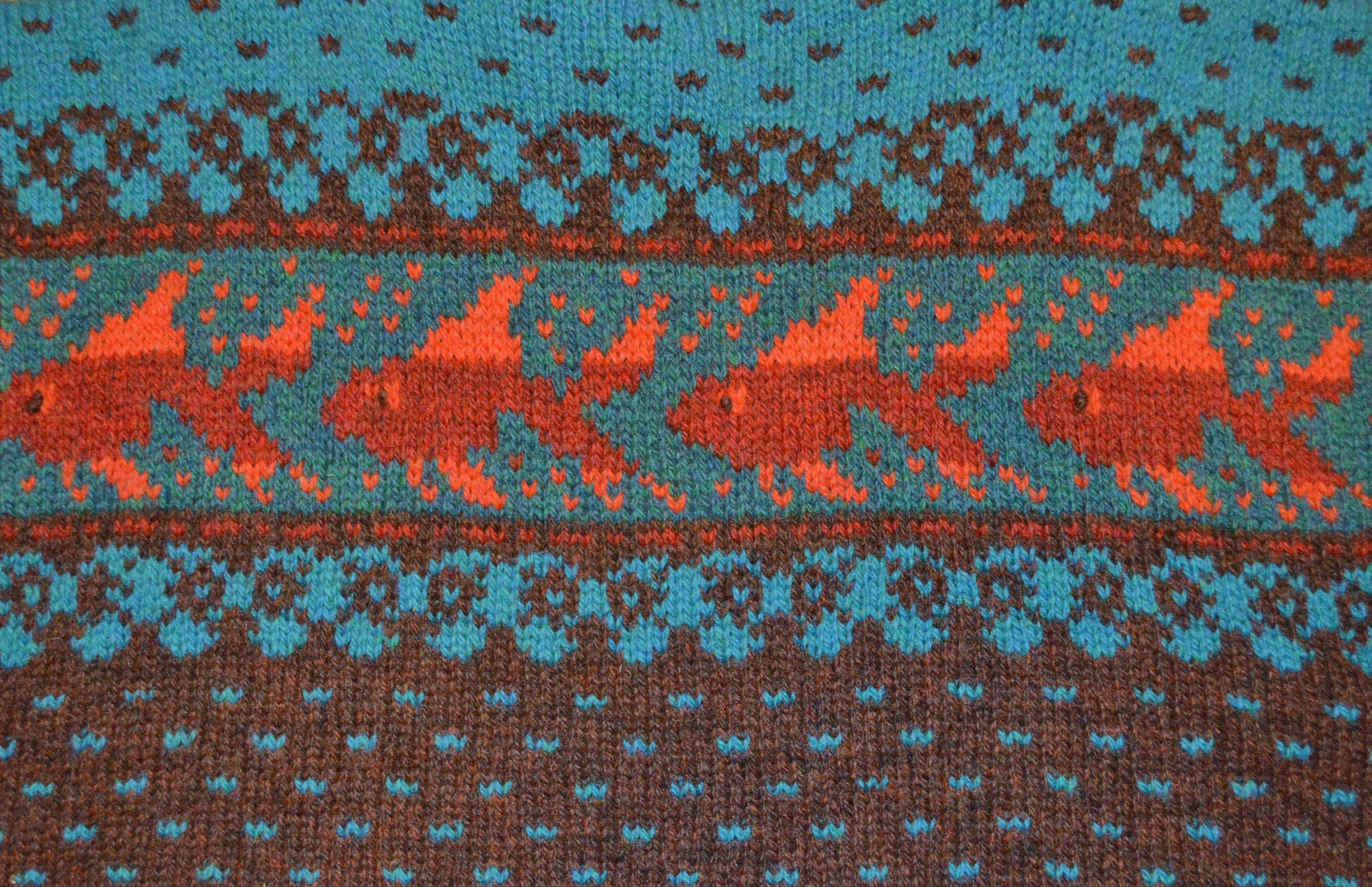
This piece defies photographing for some reason, but just believe me, it's way cool, and it's my first-ever Rowan pattern.  I made myself wait to start it until I was between "work knitting" projects, so it was the perfect thing to take on vacation. 

It's true what they say about all work and no play making us dull.  The only trouble is that I love my work so much it feels like play.  So not only is it hard to say when I'm done, it's darn hard to tell when I need a break.  Fortunately for me, I'm surrounded by people who aren't shy about telling me to get out of town.  Good thing I don't take it personally.


All's Well That Ends


All of my sniveling to the contrary, I really do love deadlines.  The thing is, once a deadline arrives, you're done.  Either you have achieved the goal of getting so much work done in so much time, or you have not.  Either way, things are going to change.  Either you get your life back, or there's a new deadline (and perhaps some extra grief).  A deadline is a day you can look forward to with the certainty that come what may, the stress of having anticipated it will be over.

Today I finished the Project-Who-Shall-Not-Be-Named.  I put it in a box, and told the Smallies that although we will never see this sweater again, it will be returned to us, in the form of Back-To-School money.  Lindsay played along: "You mean the sweater will magically transform into three-ring binders and sparkly sneakers?"  "Yes,'" I told her. "Yes, it will."  It's the Magic of Knitting.


And then, on the advice of a dear one who has really done some heavy lifting in seeing me through this particular journey, I did something very Un-Knitting.  I taught one of my kids (I could only catch one, so far, but I have plans to expose the other one, as well) how to hand quilt.


A few weeks ago we cleaned out the linen closet, and Lindsay asked me why we never use this quilt.  "Because it's not finished.  It's actually not really a quilt at all, yet."  On closer examination, we determined that I had completed about half of the quilting before I wadded it into the linen closet (okay, it was more like three linen closets ago).  Lindsay takes its unfinished state as a personal challenge (don't know where she gets these notions).  Her goal is to help (force) me to finish it before the end of winter.  She feels it's wrong that we both need a quilt to snuggle under, and that we have one which isn't finished.  She also kinda digs that you have to sit under it to work on it - kid is a hard-core snuggler.

Correct me if I'm wrong, but did I just get another deadline?


Disasters Come in Sets of Three


There I was, careening toward my deadline for the Sweater-Which-Shall-Not-Be-Named.  Ponytails akimbo.  Heart pounding.  Cuff problem sort of, possibly, intellectually solved.

That's when I noticed Problem #2.  I'm calling it Problem #2, but it could just as well have been Problem #1, had it not been eclipsed by the obviousness of the Cuff Thing:  My sleeves weren't growing wider fast enough.  By which I mean that a cuff which begins with too few stitches in it will, by definition, beget a sleeve which has also not got enough stitches in it.  Even if you are doggedly and predictably increasing it every few rows.  That's right, Gentle Readers.  Sleeves which are too narrow to start with, it turns out, tend to stay too narrow, in spite of the maker's regular increases, time spent trying, and delusions to the contrary.  Crap.

I was standing in line at the bank, working on the conjoined sleeve tube, cogitating on these and other mysteries.  The guy behind me said "I think you're next".  I thought, "Brother, you don't know the half of it," before I realized he was indicating the available teller window ahead of me.  I startled like a lobster smelling melted butter and lurched forward, embarrassed at having held up the line.  My still-knitting hands were on autopilot, and missed the memo from my startled brain and forward-moving legs.  In what can only be described as a collision between a fugue-state and consciousness, my hands attempted to move the knitting forward on my circular needle at exactly the same time as my feet stepped gingerly around the velvet rope in front of me, at exactly the same time as my brain was trying to process the fact that it was time to interact with other life forms and I had no memory of what I was supposed to be doing here. 

The snapping sensation between the fingers of my right hand was both unmistakable and sickening.  The delicate size 2 wooden needle I had been using buckled under the pressure.  Poor wee size 2.  We hardly knew ye.

The bank teller looked at me with a sympathy that could only be worn by a knitter.  "I do that all the time," she said, compassionately.  "I've even managed to snap plastic knitting needles before."  I knew there was a reason I love this bank.  Who would have expected to find understanding like that at a teller's window?

My banking (mercifully - there was math involved) concluded, I headed directly home to replace the needle and see what could be done.  In spite of the misfortune, I was feeling a bit smug.  See, in an extremely uncharacteristic fit of forethought last week, I realized that I might be headed for trouble, because I knew I would be asking a lot of my favorite skinny little wooden knitting needles in the next few days.  I actually imagined what would happen if I managed to break my only size 2 needle, and quickly ordered a new one as insurance.  So sure was I that this was going to happen, I even ordered a corresponding needle in metal, just to be sure.  Good thinking, no?  Imagine someone as impulsive as I am, actually predicting the demise of my favorite needle and planning for the eventuality!  Pleased with myself?  A bit.

Or at least I was, until I understood that the new backup needles were the wrong length.  That's right.  Water, water, everywhere, and not a drop to drink.  I had assumed that the needle I would break would be the long one I used for the body.  The one I actually snapped was the shorter, sleeve-size version.

I tried it all, man.  Magic loop.  Two circulars.  Even, bizarrely, a collection of 8 DPNs, just to see what would happen.  Not Good.  I tried the too-long, the too-short. the too narrow by .25mm.  Everything failed, and failed again.  Nothing was comfortable, and nothing allowed me to get any speed.  So I just kept changing back and forth between different imperfect tools, all the while imagining different solutions to the cuff problem, the too-narrow sleeve problem, and the all-needles-wrong problem.

This went on for no less than three days and three nights. I ate sleeve problems.  I drank sleeve problems.  I collapsed  in a fetal pile and dreamt, what else? Sleeve Problems.  At one very low point, I dreamed that the solution was to reverse the hypotenuse of the sleeve increases to the top of the arm, leave the cuff too small and let it lay open, as a decorative slot over the wrist.  It even seemed plausible, until I regained consciousness sufficiently to realize that while I could probably knit that, I doubted sincerely my ability to write directions for it that anyone could follow.

Somewhere in the sleep-deprived sleeve knitting, a very simple notion presented itself to me.  Since my conjoined-sleeve tube (appearances to the contrary) was getting bigger as I worked, If I kept knitting until the big end was big enough, maybe I could cut off the too-small end of the tube at the bottom!


And that's exactly what I did.  Some ideas are just crazy enough to work.

While the sleeves are drying, I'm taking a break.  From sleeves.  From math. And from being awake.  Deadline's still coming, but I'm hoping that the Knitting Gods are as tired of this particular episode as I am.  Gentle Readers, place your bets.


Off The Cuff


So there I was, minding my own business, when my extremely casual relationship with math leapt from the shadows to make sure I have no delusions of adequacy.

In my world, when I go to the lengths of my intellect to determine that 8 stitches in an inch of knitting should give me 6.75 inches of cuff circumference in 54 stitches, I am fairly smug about having figured it out.  Turns out that in my world, corrugated ribbing does not yield regular inches of knitting.

I was happily knitting along, pleased at my progress on the secret deadline project.  I was in the rare company of several of my favorite knitters.  Right in the middle of the conversation about where we were going for dinner after our little knitting party, I gasped out loud.  I had the temerity to try wrapping the cuff around my own wrist, as one does between rounds, with the smug satisfaction that this will tell her what the finished cuff might look like on an actual human wrist.

Keep in mind that this is actually TWO cuffs, conjoined into TWO siamese sleeves, being knit at the same time.  So sure was I that because I had gone to the trouble to actually perform calculations, nothing could possibly go wrong.  So confident that the sleeve would fit that I casually wrapped its cuff around my wrist, just to see how things were progressing. 

Except that the edges of the cuff didn't meet.  My friend Lisa used her superhuman cuff-wrapping skills to hold it wrapped it around my wrist for me.  Edges didn't meet.  My friend Liz muttered in her quiet way that it looked like I was hosed.  K.T. assured me that although it looked very bad indeed from way over where she was on the other side of the living room, she was sure Lisa could tell me how to fix it.  Jen meaningfully held her tongue.  "Block it!" was the final and reassuring chorus from all parties.  "You can totally fix that with sheer force of will!"  These ladies are nothing of not supportive; one of many reasons I love them.


Liz was right.  I'm hosed.  This cuff would fit a toddler, but probably not a human-sized adult model, and for sure not me.  Not to mention that if the dang thing doesn't fit a normal person, there are one or two hapless knitters who will grab their pitchforks and head for my house.  And I wouldn't blame them, either.

But, of course, I'm on a deadline to have this beastie done in 8 more days, and all the steam in the world is not likely to create the extra 3/4 s of an inch I thought were going to be in it.  What you can't see in the photo is the other 8 or so inches of conjoined sleeves above the nightmarishly small ribbed cuffs.  Those in-progress sleeves are the limiting factor, because reknitting them, after the wretched ribbing is sorted out will surely put me over the deadline.

My clever knitting friends advised me to finish the sleeves, and then, only if there is time, rework the cuffs buy cutting them off and reknitting them at a looser gauge.  God Love the Knitters.  I might have thrown myself under the next bus if they hadn't been there to lend their expertise.  Can you fathom being so smug that you don't even bother checking the gauge on the cuffs until after you are half way up the sleeves {Queue maniacal Knitting God laughter here}?

Phillip took the Smallies on an overnight trip to the water park resort, so that I could have some quiet time to declare war on the wayward cuffs knit.  Darn neighborly of him, though it's possible he was tired of explaining why Mommy was using the Naughty Language.

I have about 6 movies queued up on Netflix; all of them chosen for their knitability.  You know: no subtitles, not too complicated in the plot department, no heavy accents, and hopefully no characters that look too much alike (Phillip's not here for me to ask "which one is he again?").

I'm up to movie #3 so far, with 10.25 inches on the piece, of a probable 20 or 21 inches needed.

At least I found the measuring tape.  No reason to panic.  I'm going to just roll with it.  What could possibly go wrong?  Except for the cuff ribbing, I mean.


Was That Out Loud?


This is my first summer at home with Phillip and the kids.  It's a small house with no air conditioning, four people, two cats, several guppies and a scottish terrier, all attempting to pursue diverse goals, simultaneously.  We are holding up okay, but I think I'm starting to show signs of surface abrasion.  I keep hearing the most bizarre things coming out of my own mouth.  The others respond, without confusion.  This can only mean one of two things: 

1.  We have devolved as a microsociety into a parallel existence in which we think we are still using language to communicate, but actually are now mostly using clicks and grunts.

2.  Everyone has completely stopped listening to me and it wouldn't matter if I addressed them in Hebrew or Swahili because they react based on the thing I'm pointing at, rather than my words.

Examples of Things I can't Believe I've Heard Myself Say in the last 24 hours:

"Please don't poke a hole in the screen door with the vacuum cleaner."

"Remember to take the dead guppy that's in the freezer with you when you go to the pet store."

"Why is the house filled with flies?"

"I realize they are pretend nunchucks, but they still can hurt people."

"Honey wheat doughnuts are not health food."

"My knitting chair is covered in crumbs.  Which one of you decided it wasn't worth living anymore?"

"There are three bathrooms in this house.  This is only one of them.  You should explore the others."

"Please go find me the tire scrub brush so I can get the cottonwood off the screen door." 

"Isn't there someplace you're supposed to be right now?"

"Yes, but I don't think Tequila will freeze."

Ahh, Togetherness.  If any of you, Gentle Readers, are in need of a visit from a knitting teacher, kindly drop me a line?  Have Yarn.  Will Travel.


The Seat Of Power


Lindsay and I recovered the dining room chair seats.


We settled on a nice bumpy leather this time, tired as we are of trying to remove/keep spills off the old fabric covers.  We have had these chairs only about as long as we have had Lindsay (11 years), but this is already the 5th incarnation of their seats. 

I casually mentioned this to the man who measured out the new covering for us.  Without any prompting, he launched into a history of his family's dining room furniture, and its many maintenance challenges.  Mike, as it turns out, is the oldest of five children, whose mother recovered their dining room chair seats so often that he swore she could do it in her sleep.  It was his job to pull out the old staples each time, so his memories of the process are both clear and deeply etched.  I asked him what kind of dining room chairs he has now:  Molded plastic bar stools.  Lad seems to have retained the lessons of his youth.

Later that same day I was on the phone with a friend and mentioned our chair seat odyssey.  "Oh my gosh!" she said, "I'm doing that same project myself in a couple of days.  My mother visited last week and daintily spread a tea towel over the dining room chair seat before she would sit down." 

Seems to me that both mothers and dining chairs are universal: both purpose-driven, and both prone to getting smeared with gravy. 

I bet every single one of us has at least one memory of the dining room furniture of our youth, and the maintenance thereof.  Even Phillip, who can't remember my middle name, can tell you that the seats used to be blue when he was a kid, until they changed to green, and for some reason he never liked them as well after that.  I happen to know that in reality, the chair seats changed color the same year Phillip's parents divorced, and it was actually the family dining experience that he no longer liked as well.  Funny the way things are.

While we reupholstered, Lindsay and I had a conversation about why chair seats even matter in the first place.  I explained to her that there have been studies which show that children who regularly have dinner with their families get better grades, are healthier and happier than kids who don't.  If sitting down together has that much impact, the room we do it in deserves our special attention every now and then.

What I didn't tell her is that the memories she and her brother form of our daily bread and the time we spend together eating it are as important to me as their first days of school, our family vacations, or any other cherished thing.  Anybody who has had the great blessing of a home in which to live, and a dedicated space within it to share meals can tell you:  The true seat of power is the Dining Room Chair.


Kilt By Association


Of the three Scott daughters and the two Scott daughters-in-law in my family, I am the only one who can sew.  This is a dubious distinction, since it means that the care and keeping of the kilts worn by our clan has fallen exclusively to me.  I'm not complaining; I love Scottish clothing, and everything about the way it's made.  I count myself as one of the keepers of my family history, and this is the way I do it.  Some people archive photographs, some trace geneology.  I look after the tartan.

I am fortunate to have learnt at the knee of some pretty fine tailors in my time.  Some of them taught me to bag vest linings, One taught me to tie a ballet tutu (highly guarded trade secret: don't ask), from one I learned the gentle art of kiltmaking, and still another taught me to shorten a man's sportcoat sleeve in ten minutes or less.  Be advised that this last is more about being swift with the needle than any clever tailoring tricks.

These skills, I felt confident, should have prepared me for altering the sleeves on my brother David's gorgeous new kilt jacket.  For the uninitiated, a kilt jacket is very special, in that its proportions are specifically designed to follow the rules of kilt-wearing; namely that it has to be the perfect length in relation to the length of the kilt's pleat stitches.  Too short and the lad wearing it looks like a bullfighter, too long and he's a Catholic school girl.  David procured his stunning specimen in Scotland last year, where his tailor fitted it to his kilt with precision.  The tailor was too behind on work though, to perform any sleeve magic before David had to go back to the U.S.  Knowing what shipping a jacket from the UK would cost should he leave it for further work, and knowing that his sister loves him, David brought his jacket home to me.

Here is the first thing that happens when you have to shorten a kilt sleeve (okay, second; the first was a medicinal belt of Single-Malt to put me in the proper spirit):  You gut the thing.


Here's the poor wee beastie with all 8 of its gauntlet cuff seams torn asunder.  If you are at all clever, this process will cure you from any further interest in kilt-jacket-cuff-gutting.  Nasty piece of work, that.

The next part is simple, but not easy:  You have to cut into the perfect Harris Tweed fabric with your long shiny shears.  You need both confidence and fortitude.  Having cut open a few hundred sweater steeks is good preparation for this moment.  So, in my case, was a second draught of Single-Malt.  I needed it for spine-stiffening purposes.


Here the cut is made, the deed done.  No going back from this point.  And if the 3/4" that I measured (about six times, just to be sure) is not the same 3/4" that David and I agreed should come off, I am well and truly screwed.  You can always make it shorter, but longer is a bitch.

Next came the suturing up, wherein I closed up all 8 seams, one by one, by hand.  The needle was sharp, the light good, the thread strong and knotless.  All the planets were aligned.  I know that they were, because everything went neatly back into the exact place where it had been before demolition.  I felt pretty smug about things, and pondered another wee dram as a reward for my hard work. 

Which is, of course, when I saw it:


This is a picture of the Tailoring Gods laughing at me to the point of Snot Bubbles.  My hand, in this picture, is neatly inserted into a specially-finished slot in the kilt jacket lining.  Prior observation of this slot's existence would have saved me opening and closing ALL 8 SEAMS.  That's right, Gentle Readers: The brilliant Scottish tailor (factory seamstress, probably) who built this jacket had the cleverness to recognise that its gauntlet cuff faced a high probability of alteration.  He/She cunningly included this inspired lining device, in order to save me and my ilk from preforming the very surgery that I had just done.  I cannot believe the sexiness of this lining slot.  I have seen many things that tailors do in order to save (and yes, torture) their brethren, and this one takes the shortbread.  If only I had SEEN IT in time. 

I'm blaming the Single-Malt.  Everybody knows drunks can't sew.


Looks pretty yar, if I do say it though.  Calls for a congratulatory dram, I think.